
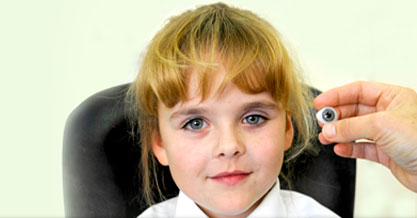
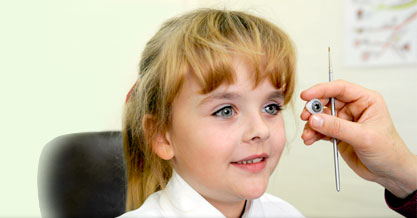
Eye transplants and stem cells.

Science is slowly catching up with science fiction. Doctors can transplant the heart, lung, liver, kidneys and more recently hand transplants. Parts of the eye such as corneal transplants are also available.

The holy grail would be an eye transplant or the ability to regrow an eye with the help of stem cells. While there is no real prospect of achieving this in the near future there is continuing research working towards this end.

The three main impediments to transplanting a human eye are maintenance of donor eye viability, optic-nerve regeneration and restoration of topographic organisation, and avoidance of immunological rejection.

Reattaching the millions of nerves  of the optic nerve to allow transfer of the information from the eye to the brain is the greatest impediment to achieving a viable eye transplant. If we are able to achieve this we still have the complications of restoring the circulation to the eye, balancing pressure of the transplanted eye and maintaining corneal health.

The earliest record of an eye transplant dates back to 1885 when a rabbit eye was transplanted into a human orbit. Since then there has been numerous attempts to transplant a mammalian eye. Although some of the studies establish “success” in other capacities, no visual function was recovered following transplantation.

There has been some success with eye transplantation performed in cold-blooded vertebrate.

A frog with the transplanted artificial eye on the left.

Professor Makoto Asashima of Tokyo University in Japan has used stem cell-like cells from a frog embryo to grow complete eyes which were then successfully transplanted into tadpoles.

Professor Asashima  believes that his groundbreaking research could pave the way for the same procedure to be used to restore vision in humans.

So far, Professor Asashima and his team have transplanted new eyes into about 60 tadpoles, of which nearly three-quarters could then see. And 7 of the transplanted eyes have survived the metamorphosis from tadpole to frog.

More recently  Embryonic stem cells from mice have been transformed into a rudimentary eye. The eye was not grown to the fully developed stage but  raises hopes of growing parts of the human eye to investigate and treat blindness.

One of the concerns people have when faced with the prospect of having an eye removed is whether they are going to be able to have an eye transplant if / when the technology becomes available.

A  message that comes through in all the articles I have read on this topic is that while we are hopeful that this technology will be available one day, it is not something that will be available  in the near future.

Ophthalmologists I have talked to about this have advised that talk of eye transplants and bionic eye replacements is only giving people false hope and the technology is still very much in the realm or science fiction.

I feel that while it is important to be realistic about prospect of eye transplant technology being available in my life time, it is encouraging to see that there is research being done in this area.

You can read more about Professor Makoto Asashima and his transplanted frogs eyes Here

Information on the” Simple eye grown from stem cells” can be found on the Guardian website Here


Bionic Eyes. Science or science fiction

“Gentlemen, we can rebuild him. We have the technology. We have the capability to build the world’s first bionic man. Steve Austin will be that man. Better than he was before. Better…stronger…faster.”
In the 1970’s television show “The six million dollar man, Major Steve Austin is severely injured and is “rebuilt”. His right arm, both legs and the left eye are replaced by “bionic” implants that enhance his strength, speed and vision far above human norms: he can run at speeds of 60 miles per hour , and his eye has a 20:1 zoom lens and infrared capabilities.

When headlines of a new bionic eye turned up in the media it would have caught the interest of anyone who wears an artificial eye. When you read the small print you will find the bionic eye is being developed for people with certain types of eye disease and is not a replacement for someone who has lost an eye.

The development of bionic vision technology aims to restore the sense of vision to people living with blindness and low vision. Initially, the technology targets patients with retinitis pigmentosa and age-related macular degeneration.

The bionic vision system consists of a camera, attached to a pair of glasses, which transmits high-frequency radio signals to a microchip implanted in the retina. Electrodes on the implanted chip convert these signals into electrical impulses to stimulate cells in the retina that connect to the optic nerve. These impulses are then passed down along the optic nerve to the vision processing centres of the brain, where they are interpreted as an image.

To benefit from this technology, patients need to have a functional visual pathway from the retina to the brain along the optic nerve, as well as some intact retinal cells. While this technology will not be able to help people who have lost an eye it is still a remarkable piece of technology and gives hope to people who suffer with retinitis pigmentosa and age-related macular degeneration.

You can read more about this technology at the Bionic Vision Australia Website


Association of European Ocularists. September 2011

We cordially invite you to the Congress of the Association of European Ocularists which will take place at The Hague, the Netherlands on Thursday September 29 and Friday September 30 2011.

The aim of the Congress of the Association of European Ocularists is exchanging information between ocularists in the broadest sense of the word. Everyone working in the field, either directly or indirectly, is welcome to this two-day meeting.

The conference will focus on Dutch specialists and their treatments. Also speakers from Europe and other continents will be present. The official language during the congress will be English.

The theme of the conference will be ‘Working together’. Working together in the broadest sense of the word. Collaborating with your patients, your colleages, your doctors and your family. Or collabaration within your organisation (AEO/ASO), your network or in your country and culture. But also consider the interaction of your knowledge, emotions, choices and time! We hope you would like to share with us your experiences about working with you suppliers and your equipment as well!

Please provide us with your input.

This website is a temporary website until December 2011 and will contain information about the 7th conference organized bij the Association.

Here you will find all information about the program of the congress, your registration and your stay at The Hague.

We hope that you will register for this conference and will have an enjoyable stay in our wonderful city.

Thus we would like to welcome you to the Congress of the Association of European Ocularists 2011 at beautiful The Hague, The Netherlands on Thursday 29 and Friday 30 September 2011.

Axel Franken

Organizer AEO Conference 2011

Dutch Ocularist

For details please visit the official website of Association of European Ocularists 2011


Ocularists Association of Southern Africa

OASA Congress 2011

Dear Colleagues

It is a great honor and privilege to invite you to join us in the world famous Kruger National Park for our 9th Annual Congress.

Please feel free to pass this invitation on to any Ocularists you think may be interested, or display the invitation on your official association website.

Program and other relevant details will follow soon.

RSVP & any queries: OASA Congress 2011 Coordinator Chantal Kritzinger: congress2011@oasa.org.za

Kind regards

Pedro Carvalho

President Ocularists Association of Southern Africa

Fax – 011 7043775

Cell – 0823370203

Email - president@oasa.org.za

Web - www.oasa.org.za

Congress 2011

You are personally invited to attend the

9th Annual OASA Congress

Join us at Kruger Park in South Africa, a wildlife paradise,
teaming with life. The ultimate destination for the tourist seeking
indigenous flora, fertile valleys, sub-tropical Lowveld vegetation
and diversity of wild life and habitat.

If you are interested in presenting a paper,
please contact Chantal.

We’re looking forward to welcoming you.

Venue: Berg-en-Dal Rest Camp at Kruger National Park

Date: 14-17 August 2011

RSVP: OASA Congress 2011 Coordinator Chantal Kritzinger
Limited places available
Cell:+27 (0)83 2367670
Email: congress2011@oasa.org.za

Congress 2011

Download this OASA Congress 2011 Invitation as PDF (Size 463KB)


Playing Sport After Eye Loss

This week we launched a new project called Your Story in Words and Pictures.

There is a new button on our home page where people can share their story of eye loss with others. You can even upload a photo of yourself if you like.

We have just had our first story submitted and I am so pleased to publish it and share it with you.

We’ve called the story, I Still Love To Play Sport and it was sent in by Bruce who is a keen sportsman.

Thanks Bruce for sharing this inspiring story which encourages people to follow their passions and not let eye loss stop them doing the things they love.

I am frequently meeting people who are worried about how eye loss will change their participation in sport.

This is a great story to show them.

If you have a story you would like to share with others please use the button on our front page – we’d love to hear from you.


Hitting The Water With An Artificial Eye

People often ask me how they should care for their artificial eye when swimming.

I think it’s ideal to wear goggles while doing laps or for more vigorous water activities.  

However, goggles won’t help if you’re diving into water or waterskiing.

For these activities I recommend closing the eyes tightly when hitting the water and putting a hand over the eye if possible.

For activities like surfing, body surfing and skiing I also recommend that a person wears an old prosthesis as hitting the water can dislodge an eye prosthesis.

Most eye prostheses are quite secure in the socket. 

Usually clients find that it’s ok to have a gentle dip without goggles.

It is only when the water forces down on the bottom lid that the prosthesis can become dislodged.

Enjoy your swim.


New Website For Ocularists

We’ve been thrilled with the response we have had to this website both from ocularists as well as people with eye loss.

As the site has grown we’ve come to realise that ocularists need a website specifically for their own professional interests.

This has been my motivation in launching the new site Resources For Ocularists.

In the future I would love to build a set of resources that can help promote the knowledge base of ocularists world wide.

If you are an ocularist who would like to contribute to this project I would be happy to hear from you.


Malaysia Artificial Eyes -Peter T Knowles Ocularist/Prosthetist

An update on our Ocular Prosthetic services in KL Malaysia.

In December 2010 we completed our second year of Artificial Eye treatment for Malaysia at the Sunway Medical Centre. This Clinic is based in the Centres of Excellence at the Sunway Medical Centre. It has been providing a premium, custom Artificial Eye service now for 2 years.

Artificial Eyes are being made for patients from not only Malaysia but also Singapore, Thailand, Indonesia and VIP patients from Rowanda and Pakistan.

The nursing staff at the Sunway Medical Centre Eye Clinic are becoming increasingly familiar with the treatment and processes surrounding Artificial Eye procedures and patient care, ensuring a pleasant and enjoyable experience for our respected patients.

We have agreed with the Sunway Medical Centre to continue this Premium Artificial Eye Service for the coming next three years – commencing on February 21st for two weeks and every three months onwards.

We are happy to provide a pre-treatment consult for patients with queries, questions or concerns.

 Dates for 2011

21st Feb – 5th March

23rd May – 4th June

1st Aug – 13th Aug

7th Nov – 20th Nov.

We look forward to helping more people regain their confidence and self esteem by providing them with an Artificial Eye most suited to their specific needs and requirements.

For appointments and further details please look here

Peter T Knowles Ocularist/Prosthetist


Profile Page Helps Introduce Local Ocularist

I’ve just had the pleasure of creating a profile page for Greg Sankey who has artificial eye clinics in Seattle and Greece.

Greg is part of a three generation ocularist family.

He followed his father in the business. Now his children are both in the practice as well.

Greg already had a diverse internet presence that involved separate websites for his different clinics.

His new profile page will enable him to feature when people are searching for an ocularist using geographical location on google. 

For example if they are looking for assistance using the words “artificial eyes Seattle” they will now find Greg’s profile page.

Greg also consults in Greece. His profile page will make him more accessible in that locality as well.

I have enjoyed learning more about Greg and his practice.  He is clearly a dedicated professional.  

I’m very pleased that his profile page will make him more accessible.

People feel more confident visiting an ocularist when they can learn more about them from a web page.

In our own practice we noticed that people are much less anxious during their first visit.  They have read about us online and we are no longer strangers.


Dubai artificial eyes update December 2010

After twenty years of practicing my trade as an ocularist in Australia I have branched out and have been consulting in Dubai for the past two year. I consult at Moorfields Eye Hospital Dubai which is located at Dubai Healthcare city. Moorfields Eye Hospital Dubai is a branch of Moorfields London. Moorfields London was founded in 1804 and opened in 1805 in London. It is the oldest and one of the largest centres for ophthalmic treatment, teaching and research in the world. It is the largest eye care facility in Europe.

On this visit I have had the pleasure of presenting a talk to the clinical staff at Moorfields hospital on “Orbital Implants , An Ocularists Perspective”. In the talk I covered the purposes of the orbital implant and the pros and cons of the various implants available. Public speaking is not one of my strong points so while I was nervous preparing the talk I am happy that the clinical staff gave me a warm welcome and appeared interested which made it easier for me.

Something else I have started doing this trip is visiting  the eye clinics at the other hospitals here in Dubai to let the ophthalmologists know about the services I provide. I had the pleasure of visiting Dr Millicent Grim at the Gulf Eye Centre. Dr Grim has been consulting in Dubai since 2002 and has a well established practice set up at the Fairmont Hotels Office Suites on Sheikh Zayed Road.  
I visit Dubai four times a year in March, June, September and December
Appointments can be made through the Moorfields Eye Hospital Dubai web site or by calling the number below.

Telephone (+971) 4 429 7888

Mailing Address
Moorfields Eye Hospital Dubai
Dubai Healthcare City
P.O. Box 505054
Dubai
United Arab Emirates

Telephone (+971) 4 429 7888
Fax (+971) 4 339 5303
Email paul.geelen@moorfields.ae
The hospital is located in Al Razi Building in Dubai Healthcare City, Block E, 3rd Floor.