Adapting To Monocular Vision
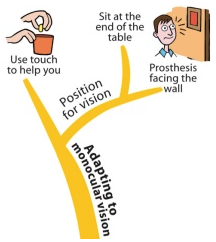
Mind Map: Adapting to Monocular Vision
There are two visual aspects that are associated with monocular vision. You have a reduced field of vision and your ability to judge distance is impaired.
Peripheral Vision
With only the one eye you has lose approximately 20% of your peripheral vision.
You can test this by holding your arms out to the side and bringing them in until you can see your hand.
While this is not a significant part of his field of vision there are adjustments you will have to make. It will create many minor embarrassing and frustrating situations. It is most noticeable in crowded areas where you will bump into people on his blind side. Many people have told me that they will try to walk with a partner or a wall on the blind side to prevent this problem.
You will also have people approaching him on the blind side and accuse you of being rude because he will not acknowledge them. This is particularly apparent when you are sitting at a table and are required to turn his back on the person on one side when addressing the person on his other side.
Depth perception
With the loss of his binocular vision you not going to be able to judge distances as well as you used to. This poses challenges to everyday things such as pouring a drink or shaking hands. He will need to be more careful with driving and ball sports will be challenging as it is more difficult to track a moving object.
Coming To Dinner
Mind Map: Adapting to Monocular Vision
Arrive Early
If you are the first to the table you can choose a seat at the end of the table where it is easy to see everyone without having to turn your head.
Eating Gets Easier
Eating at first will feel a bit tricky as your fork and your glass will be in slightly different places from where you think they are. Take things slowly and remind yourself that you will very soon get used to where everything is.
Develop a Good Pick Up Line
You will experience a little difficulty judging distance properly. This can lead to knocking things over when you reach for them. Develop a habit of of reaching out for things and stop before you can touch it. This is your pick up line. Move your hand the last little distance very slowly.
Rest Easy With Pouring
With monocular vision pouring liquids can be a bit hazardous at first. The trick here is to very slowly place the lip of the bottle directly on the rim of the cup or glass.
Careful Near The Stove
Wearing gloves near the stove or barb-b-que will help protect you from burns as you get used to where things are and how you need to make adjustments for your new view on the world.
Getting Out & About
Get Some Perspective
If you are standing directly over a container when pouring it may be difficult to accurately judge when how full it is. By standing slightly back you'll be able to see more of the container and gain an accurate assessment of how full it is.
Shadows Need Perspective Too
Shadows cast by objects illuminated by artificial light at night will appear to be a part of an overall object. Again, standing at a different angle will help here as well.
Beware the Mirror Menace
Dim lighting is a challenge. Large mirrors in dim lighting can appear to be an extension of the room. In these situations there is a risk of walking straight into mirrors.
Avoid Falls on Stairs and Gutters
Looking down on stairs and gutters gives a false message of depth. Make a mental note to take care when walking down stairs. Use the handrail to give yourself extra support. Make sure you take particular notice of the last step.
Negotiate gutters carefully. To avoid a fall, slow right down, look at the gutter as you approach so your brain can work out the drop from several angles as you approach. After a while your brain will perform a lot of these tasks automatically.
Resources
" A One Eyed View of Life", Terry Spring
Monocular vision was brainstormed by the support group “Cyclops Circle”. Terry Spring compiled the information in his book “A one Eyed View of Life”. This book highlights the challenges of work, sports, driving and just about every other aspect of living with monocular vision.
Dr Thomas Politzer Implications of Acquired Monocular Vision (loss of one eye)
This article was written for the NORA (Neuro-Optometric Rehabilitation Association).
The article makes interesting reading for people who are adjusting to monocular vision. It also helps to educate others about the challenges for people with monocular vision.
The article includes literature, occupational concerns, safety and eye protection, driving, activities of daily living, future risk, hobbies, loss and impairment, cosmetic issues and rehabilitation.
You can read his article Here
